 Toll-Free:


DBQ Thesis Formula: Templates and Examples That Earn the Thesis Point
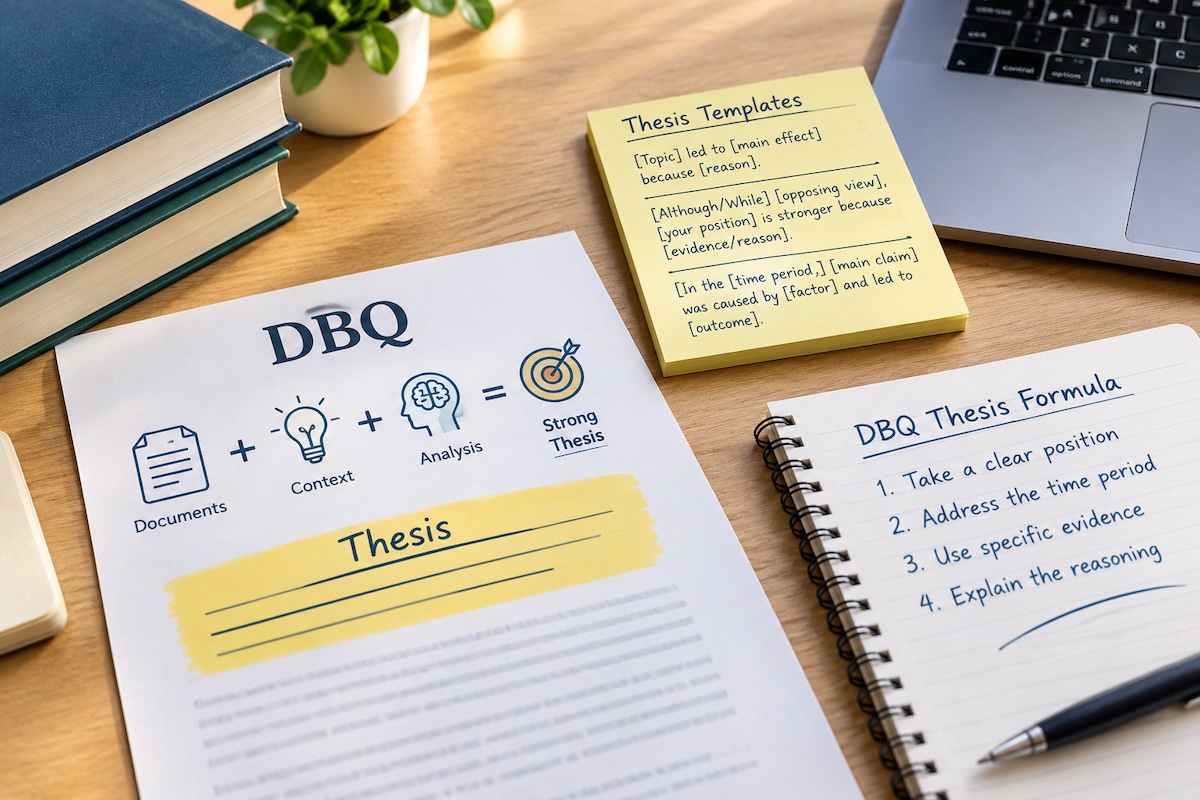
The DBQ thesis formula is: Although [counterclaim], [claim] because [reason 1] and [reason 2]. One or two sentences in this shape meet the College Board’s rule: a defensible claim with a line of reasoning.
A DBQ thesis formula turns the hardest sentence on the AP History exam into a fill-in task. The document-based question opens Section II of APUSH, AP World History: Modern and AP European History. Your thesis sets up the points that follow. Canadian AP students use the same rubric, so these templates work wherever you write the exam.
Verified October 6, 2026, against the College Board’s 2025 AP U.S. History scoring guidelines.
Key Takeaways
- The thesis is worth one of seven DBQ points, and it shapes the other six.
- You need a defensible claim plus a reason for it or categories for your argument.
- Keep it in one place: the introduction or the conclusion.
- A restated prompt or a sweeping claim earns zero.
Quick Answers
| Question | Short answer |
| The formula | Although [counterclaim], [claim] because [reason 1] and [reason 2] |
| Where it goes | The introduction or the conclusion, in one place |
| How long | One or two sentences |
| Counterclaim required? | No, but it adds nuance and sets up the complexity point |
| Can it earn complexity alone? | No; complexity has to run through your argument |
Practising DBQs before the exam? Our history editors give line-by-line feedback on your practice essays. Get a free quote.
What Does the DBQ Rubric Require for a Thesis?
You earn the point with a defensible claim that answers the prompt and sets up a line of reasoning. The College Board’s 2025 AP U.S. History scoring guidelines define that line of reasoning. Your claim must give a reason or set up categories for the argument.
Readers deny the point when a thesis:
- Restates or rephrases the prompt.
- Makes a claim with no reasoning.
- Overgeneralizes.
- Gets the history wrong.
The thesis is one row of a seven-point rubric:
| Rubric row | Points | What earns it |
| Thesis/Claim | 1 | Defensible claim with a line of reasoning |
| Contextualization | 1 | Broader historical context relevant to the prompt |
| Evidence from documents | 2 | Content of three documents for 1 point; an argument using four for 2 |
| Evidence beyond the documents | 1 | One relevant piece of outside evidence |
| Sourcing | 1 | Point of view, purpose, historical situation or audience explained for two documents |
| Complexity | 1 | A complex understanding woven through the argument |
New to thesis writing? Start with our guide on how to write a thesis statement.
What Is the DBQ Thesis Formula?
The formula has three parts: a counterclaim, your claim and your reasons.
Although [the strongest opposing point], [your answer to the prompt], because [reason 1] and [reason 2].
Each part has a job:
- Although [counterclaim]. Shows you weighed the other side. It is optional, but it adds nuance.
- [Claim]. Answers the exact question. If the prompt asks “to what extent,” name an extent.
- Because [reasons]. Creates the line of reasoning. Each reason becomes a body paragraph with its own group of documents.
This gives you a closed thesis that previews your categories. Our post on open vs closed thesis statements explains when each style fits.
How Do You Write a DBQ Thesis Step by Step?
Read the prompt, read the documents, pick a side and fill in the formula before you write your introduction.
- Mark the task verb. “Evaluate the extent,” “compare” or “explain the causes” tells you which template to use.
- Note the time frame and topic. Your claim has to stay inside both.
- Sort the documents. Tag each one with a short label for the idea it supports. Two or three labels will emerge.
- Choose your answer. Pick the position most documents support. The ones that cut against it become your counterclaim.
- Fill the formula. Your labels become the “because” reasons. The outliers become the “although” clause.
- Check it against the prompt. If your sentence could answer a different question, tighten the claim.
With practice, this takes about five minutes. The College Board’s AP U.S. History exam page has past prompts you can rehearse with.
DBQ Thesis Templates by Reasoning Type
Pick the template that matches the skill the prompt tests: causation, continuity and change, comparison or extent.
Causation
Template: Although [secondary cause] played a role, [main cause] was the most significant cause of [event], because [reason 1] and [reason 2].
Example: “Although religion drove some voyages, the search for Asian spices and gold was the main cause of European exploration from 1450 to 1750. Merchants wanted to bypass Ottoman and Venetian middlemen, and monarchs needed new wealth to fund their states.”
Continuity and Change Over Time
Template: From [start date] to [end date], [topic] changed in [category 1] and [category 2], although [continuity] remained.
Example: “From 1940 to 1975, American women gained economic and legal rights through wartime jobs, rising college enrolment and second-wave feminism. Many still faced pressure to return to domestic roles after the Second World War.”
Comparison
Template: Both [A] and [B] [similarity], but they differed in [category 1] and [category 2].
Example: “The German and English Reformations both broke with Rome, but they differed in origin and pace. Luther’s movement began as a theological challenge that princes adopted. England’s began as Henry VIII’s political break and took on Protestant doctrine later.”
For more on weighing similarities against differences, see how to write a comparative essay.
Extent (“Evaluate the Extent…”)
Template: [Topic] changed to a [great / moderate / limited] extent, as [category 1] and [category 2], although [limit or exception].
Example: For the 2025 APUSH prompt on the federal government’s role in the economy from 1932 to 1980: “The federal role in the economy grew to a great extent, as New Deal programs, wartime controls and Great Society spending built a lasting welfare state. Conservative opposition in the 1970s began to push back.”
DBQ Thesis Examples for APUSH, AP World and AP Euro
The formula works in all three courses because they share one DBQ rubric.
| Course | Sample prompt focus | Why the thesis earns the point |
| APUSH | Federal role in the economy, 1932 to 1980 | States an extent and names three categories of evidence |
| AP World | Causes of maritime exploration, 1450 to 1750 | Ranks causes and gives two reasons |
| AP Euro | German vs English Reformation | Makes a comparative claim with two categories of difference |
Want a second reader on your DBQ? Homework Help Global’s editing services check your thesis, document use and structure against the rubric. Request a free quote.
Weak vs Strong DBQ Thesis Statements
Weak theses fail in four predictable ways, and each has a quick fix.
| Problem | Weak thesis | Strong fix |
| Restates the prompt | “The role of the federal government changed from 1932 to 1980.” | Add an extent and reasons: “grew to a great extent, as New Deal programs and wartime controls…” |
| No line of reasoning | “The economy had booms and busts in this period.” | Tie the claim to the prompt and add a “because” clause |
| Overgeneralized | “The government did not care about the economy.” | Replace sweeping language with specific developments |
| Split across paragraphs | Claim in the intro, reasons in the conclusion | Keep claim and reasons together in one place |
The first three mirror the College Board’s own failing examples. To see how a thesis differs from a single claim about a document, read our post on thesis vs claim.
The CLAIM Check: Test Your Thesis in 30 Seconds
Ask five questions before you start your first body paragraph.
- C: Compelled by the prompt. Does it answer the exact question?
- L: Line of reasoning. Does it give reasons or name your categories?
- A: Accurate history. Could a historian defend it with evidence?
- I: In one place. Do the claim and reasons sit together?
- M: Mapped to documents. Can you group at least four documents under your reasons?
Pass all five and you earn the point, plus a plan for the essay.
How Does Your Thesis Set Up the Rest of the DBQ?
Your reasons become body paragraphs, and your documents slot in under them. Sort the documents into groups before you write. If a group fits no reason, your thesis needs another category.
Your contextualization paragraph leads into the thesis. Describe what happened before or around the prompt’s time period, then state your claim.
Sample DBQ Introduction With Thesis
Here is a full introduction for the 2025 APUSH prompt, with context first and the thesis last:
In the late 1800s, many business leaders and politicians argued that government should stay out of the economy. That view lost ground after the 1929 crash, when unemployment soared and banks failed. From 1932 to 1980, the federal role in the economy grew to a great extent, as New Deal programs, wartime controls and Great Society spending built a lasting welfare state. Conservative opposition in the 1970s began to push back.
The first two sentences earn contextualization. The bolded sentences earn the thesis point and name three body paragraphs, plus a counterclaim for complexity.
The “although” clause gives you a head start on complexity. The 2025 guidelines say complexity must run through the argument. Come back to your counterclaim in the body and explain it.
The UNC Writing Center’s guide to writing in history shows how historians build arguments from sources. For longer assignments, our guide on how to write a history research paper uses the same reasoning at full length.
How Long Should a DBQ Thesis Be?
Aim for one or two sentences, about 30 to 60 words. The rubric allows more, as long as the sentences sit in one place. Longer theses tend to drift into evidence that belongs in the body.
Draft your thesis right after you read the documents. If your argument shifts as you write, revise the thesis in your conclusion. The rubric accepts either location, so a stronger version at the end still earns the point.
Frequently Asked Questions
Can a DBQ thesis be two sentences?
Yes. The College Board rubric allows one or more sentences, as long as they sit together in the introduction or the conclusion. Two sentences give you room for a claim and its reasons. That is the line of reasoning the DBQ thesis formula is built to deliver.
Does the DBQ thesis have to be in the introduction?
No. Your thesis can go in the introduction or the conclusion, but it must sit in one place. Most students put it at the end of the introduction so the reader knows the argument from the start. A revised thesis in the conclusion still earns the point.
Do I need a counterargument in my DBQ thesis?
No. The rubric asks for a defensible claim with a line of reasoning. A counterclaim is optional. An “although” clause does show nuance, and it gives you a starting point for the complexity point. You earn that point by developing the tension in your body paragraphs.
Can I use “I” in a DBQ thesis?
Avoid it. “I think” and “I will argue” add words without strengthening the claim. Use the DBQ thesis formula to state a historical claim, and let your reasons persuade. Readers score the claim itself, so spend your words on history.
Can someone review my practice DBQ?
Yes. Homework Help Global editors review practice DBQs and history assignments against the College Board rubric. We check your thesis, contextualization, document use and sourcing, and show you where you would gain or lose points. Request a free quote with your word count and deadline.
Write a Thesis That Earns the Point
A strong DBQ thesis answers the prompt, gives reasons and sits in one place. Practise the formula on past prompts until it feels automatic. Then spend your exam time on evidence and analysis. At Homework Help Global, our editors help you sharpen practice essays so the thesis point becomes routine.
Get a free quote today with your word count, deadline and course.