 Toll-Free:


Annotated Bibliography Example: APA, MLA, and Chicago Samples You Can Copy
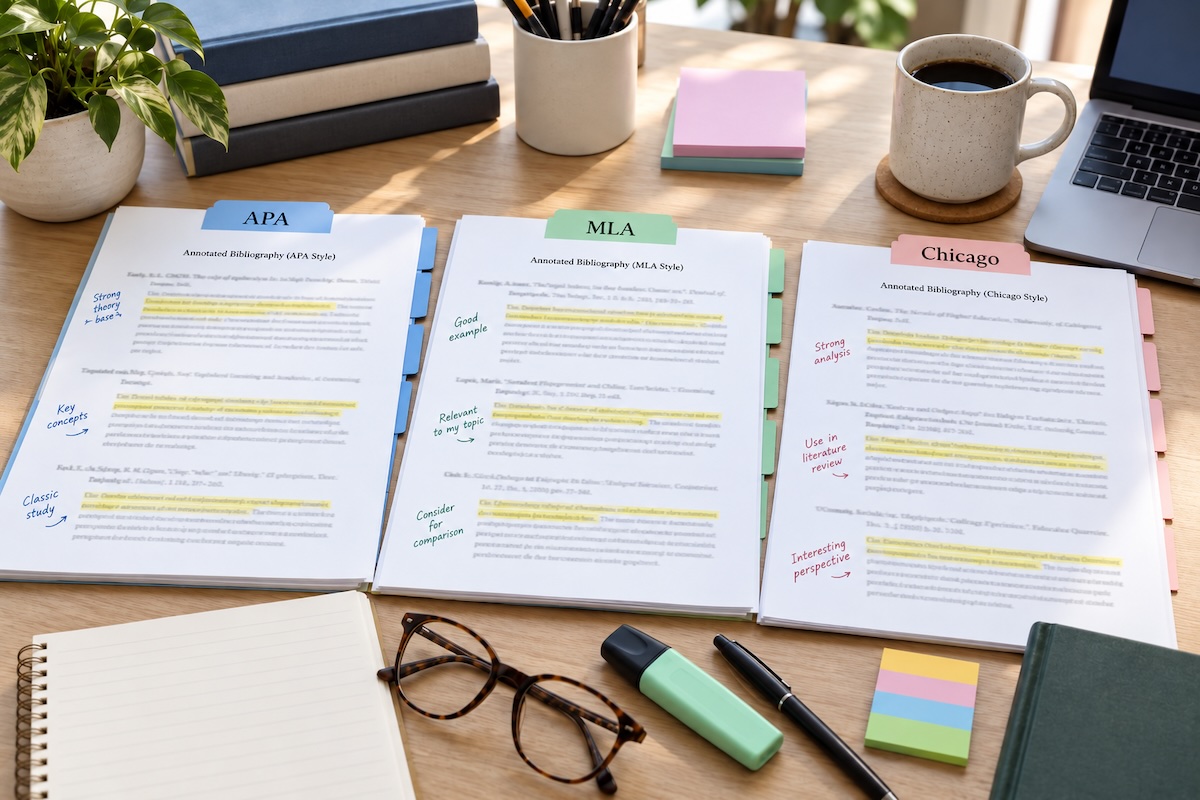
A solid annotated bibliography example solves a problem most course outlines create. Your professor asks for ten sources, 150 words per entry, APA 7 format, and then leaves you to guess what a finished entry looks like. Library guides define the assignment without showing one. Sample pages show fragments. This guide gives you three complete worked entries in APA 7, MLA 9, and Chicago style, each built on a real source you can look up, plus the rules behind them. You also get a weak entry rewritten into a strong one so you can see what earns marks and what loses them.
Key Takeaways
- Every entry has two parts: a formatted citation and an annotation paragraph beneath it.
- Most annotations run 100 to 200 words unless your rubric says otherwise.
- Entries go in alphabetical order by author surname, never in the order you read them.
- Only the citation changes between APA, MLA, and Chicago. The annotation structure stays the same.
What an Annotated Bibliography Actually Is
An annotated bibliography lists your sources in alphabetical order and places a short paragraph under each citation that summarizes and evaluates that source. The University of Toronto’s writing advice describes it as an account of the research done on a topic, with an assessment of each source’s value or relevance attached.
One distinction trips up students every term. An abstract belongs to the author of the article and describes the content. An annotation belongs to you and judges the content. If your paragraph reads like the abstract with the words shuffled, you have written the wrong thing.
Instructors assign this for a reason that shows up later. You cannot evaluate ten sources without noticing which ones disagree, which ones rest on thin evidence, and where the gap in the research sits. That gap becomes your thesis.
The Three Types of Annotation
Check your assignment sheet before you write a word, because the type determines the content.
Descriptive
A descriptive annotation summarizes the source and stops there. Example: “Carr traces the effect of internet use on reading habits, drawing on neuroplasticity research and media history from the alphabet forward.”
Evaluative
An evaluative annotation adds judgment about credibility, method, and limits. Example: “Carr writes for a general audience, so he summarizes studies without reporting sample sizes or methods, which weakens the chapters that lean hardest on experimental evidence.”
Combination
A combination annotation does both and adds a relevance statement tying the source to your project. Most Canadian course outlines ask for this version, and every example below uses it.
The SCAN Formula for Writing an Annotation
Four moves, in order, fill 150 words without padding.
- Summarize. State the source’s question, method, and main finding in two sentences.
- Critique. Judge the evidence, the sample, the date, and the author’s standing.
- Apply. Name the section of your paper this source supports.
- Note the gap. Say what the source leaves unanswered.
Students who skip the last two moves write book reports. Markers notice.
Annotated Bibliography Example in APA 7 Format
Deci, E. L., & Ryan, R. M. (2000). The “what” and “why” of goal pursuits: Human needs and the self-determination of behavior. Psychological Inquiry, 11(4), 227-268. https://doi.org/10.1207/S15327965PLI1104_01
Deci and Ryan set out self-determination theory, arguing that motivation depends on three psychological needs: autonomy, competence, and relatedness. They draw on two decades of laboratory and field studies to show that rewards and deadlines undercut intrinsic motivation when people read them as controlling. The article presents a theoretical review rather than a single study, so it reports no original data, and the evidence base leans on North American university samples. Both authors hold long records in motivation research, and the journal peer reviews its target articles alongside published commentary. This source anchors my paper’s definition of intrinsic motivation and supplies the autonomy-support construct I apply to the classroom observation data in Chapter 3. It leaves the cross-cultural question open, which is the gap my case study addresses.
Formatting notes for APA 7: the citation takes a hanging indent, the annotation sits as a new paragraph indented beneath it, article titles use sentence case, and the journal name takes italics. Our guide to APA style covers the citation mechanics for other source types.
Annotated Bibliography Example in MLA 9 Format
Carr, Nicholas. The Shallows: What the Internet Is Doing to Our Brains. W. W. Norton, 2010.
Carr argues that heavy internet use retrains the brain for scanning at the cost of sustained reading. He builds the case from neuroplasticity research, media history running from the alphabet to the printing press, and his own account of losing patience with long books. The book targets a general audience rather than a scholarly one, so Carr summarizes studies without reporting methods, and his strongest chapters rest on a small set of experiments that later work has complicated. His standing as a Pulitzer Prize finalist gives the argument reach outside academia. I use Carr to frame the popular anxiety about attention that my essay tests against reading comprehension data. His chapter on hypertext contains the specific claim I dispute in section two.
Formatting notes for MLA 9: titles take title case, the entry appears on a Works Cited page, and the annotation follows the citation with the same hanging indent. Our MLA referencing guide breaks down the core elements for books, chapters, and web sources.
Annotated Bibliography Example in Chicago Style
Kolbert, Elizabeth. The Sixth Extinction: An Unnatural History. New York: Henry Holt and Company, 2014.
Kolbert reports on the current wave of species loss by visiting field sites, from Panamanian amphibian labs to ocean acidification experiments, and sets it beside the five mass extinctions in the geological record. She writes as a journalist working from interviews with practising scientists, so the book carries no original research and its structure follows narrative rather than argument. The Pulitzer Prize for General Nonfiction in 2015 and its place on undergraduate syllabi both point to its standing as a bridge between the science and a general readership. For my environmental history paper, Kolbert supplies the long geological frame that my chapter on Canadian boreal forest loss sits inside. Her treatment of ocean chemistry gives me the mechanism I trace through the primary literature.
Chicago splits into two systems. Notes-bibliography style, shown above, dominates history and the humanities. Author-date style shifts the year forward and suits the sciences. Ask your instructor which one the course uses before you format ten entries twice.
Weak Annotation vs Strong Annotation
Same source, two attempts. The weak version:
This article is about motivation. Deci and Ryan explain self-determination theory and talk about autonomy, competence, and relatedness. It was published in Psychological Inquiry in 2000. It is a very useful source for my paper on student motivation and I will use it a lot.
Four problems cost marks here. The writer reports the topic without the finding. No judgment appears about method or evidence. The relevance statement stays vague, since “I will use it a lot” names no section and no argument. Nothing identifies what the source fails to cover.
The APA entry earlier on this page fixes all four in the same word count. It names the finding, flags the absence of original data, points at a specific chapter, and identifies the cross-cultural gap the paper fills.
Formatting and Length Rules Markers Check
- Alphabetical order by the first author’s surname across the whole list.
- 100 to 200 words per annotation, adjusted to the rubric.
- Hanging indent on every citation, with consistent spacing throughout.
- Your own words, with quotation kept to a phrase at most.
- Consistent citation style, since mixing APA punctuation into MLA entries reads as carelessness.
Our editors at Homework Help Global see the same failure across submissions every term: a student formats the first three entries with care, then drifts by entry seven. Build the list in one sitting or use a style sheet.
Five Mistakes That Cost Marks
- Weak sources. A blog post and a 1998 textbook will sink a well-written annotation. Use peer-reviewed articles and scholarly books, with the publication window your course allows.
- Copied abstracts. Markers run the same searches you do. Paraphrase, then add judgment.
- No relevance statement. Name the chapter, argument, or dataset the source supports.
- Reading order instead of alphabetical order. A quick sort fixes this in seconds and its absence signals rushed work.
- Identical entries. Ten paragraphs with the same opening clause show the marker you ran a template, not an evaluation. Vary the first move.
For help choosing sources worth annotating, our post on research topics for college students covers where credible material lives and which sources to avoid.
From Annotated Bibliography to Literature Review
The annotated bibliography stops at individual sources. A literature review connects them, grouping studies that agree, setting out the debates, and naming the gap your research enters. Your SCAN notes carry straight over, since the critique move becomes your evaluation of the field and the gap move becomes your rationale. Our literature review guide walks through that transition. The same notes also feed the source selection stage of a full research paper.
For more sample annotations across styles, Purdue OWL and the libraries at Cornell and Concordia publish free guides worth bookmarking.
Final Thoughts
An annotated bibliography rewards judgment more than writing flair. Once you can summarize a study, weigh its evidence, and say what it does for your argument, the paragraphs write themselves. The work sits in the reading.
At Homework Help Global, our team supports Canadian students at the stage where this assignment gets heavy: finding credible sources in your discipline, checking whether your annotations hit summary, evaluation, and relevance, and reviewing your citations against APA, MLA, or Chicago rules before you submit. Our writers hold graduate degrees from Canadian universities and have marked this assignment from the other side of the desk.
Visit Homework Help Global to talk to our team about research support, editing, and citation review. For study strategy between assignments, our Homework Help Show podcast covers citation habits, research workflow, and academic integrity in episodes built for students.
Frequently Asked Questions
What is an annotated bibliography example in APA format?
An annotated bibliography example in APA 7 shows a reference list entry followed by a paragraph of roughly 150 words. The citation carries a hanging indent and sentence case titles, italicizes the journal name, and the annotation sits indented beneath it. The paragraph summarizes the study’s question and findings, evaluates its method and credibility, and explains how the source supports a section of your paper. Include the DOI when the source has one.
How long should each annotation be?
Most annotations run 100 to 200 words, which works out to one focused paragraph of four to six sentences. Descriptive annotations sit at the short end. Combination annotations covering summary, evaluation, and relevance need the full range, and some graduate assignments ask for two or three paragraphs per source. Your rubric overrides any general rule, so confirm the word count before you draft ten entries at the wrong length.
How many sources does an annotated bibliography need?
Undergraduate assignments commonly ask for five to fifteen sources, while graduate work and thesis proposals often require twenty or more. Many instructors also set a source mix, such as one book, one peer-reviewed article, and one credible web source. Requirements vary by discipline and by stage of the project, so confirm the number, the source types, and the publication window on your assignment sheet before you start reading.
Do annotations go in alphabetical order?
Yes. Entries appear in alphabetical order by the first author’s surname, matching a standard reference list or Works Cited page. Reading order and topic order both lose marks. If a source has no author, alphabetize by the first significant word of the title, ignoring “A” and “The”. Some instructors permit grouping by theme or source type, with alphabetical order inside each group, so ask before you reorder a finished list.
What is the difference between an annotation and an abstract?
An abstract comes from the author of the source and describes its contents without judgment. An annotation comes from you and evaluates the source’s credibility, method, and usefulness for your own project. Every strong annotated bibliography example includes that evaluation, since a paraphrased abstract tells the marker you summarized the source without assessing it. Read the abstract to decide whether the source is worth your time, then set it aside and write your own paragraph.