 Toll-Free:


How to Write a DBQ for APUSH: Earn All 7 Rubric Points
To write a DBQ for APUSH, spend 15 minutes reading and planning, then write an essay that earns each rubric point on purpose: thesis, contextualization, evidence from four documents, one outside example, sourcing for two documents and a complexity move.
Last verified against College Board materials on October 19, 2026.
Learning how to write a DBQ for APUSH means learning to build a historical argument from seven primary sources in about an hour. The document-based question opens Section II of the AP U.S. History exam and counts for 25% of your score. College Board readers grade it on a public 7-point rubric, so you can plan for each point before you write a word.
Most students leave points on the table. In 2025, the average DBQ score sat at 3.75 out of 7 on one exam set and 3.94 on the other. This guide covers the rubric, a 60-minute method and the rows students miss most.
Key Takeaways
- You earn each of the seven points on its own, so a weak thesis does not cost you the evidence points.
- Describe three documents for one evidence point, and use four to support an argument for two.
- Sourcing and complexity scored lowest in 2025, with averages under 0.4 and under 0.2 out of 1.
- Starting in May 2027, the DBQ draws on a wider span of U.S. history, but the rubric stays the same.
Quick Answers
| Question | Answer |
| Documents provided | 7 |
| Recommended time | 60 minutes, including a 15-minute reading period |
| Share of exam score | 25% |
| Documents for full evidence credit | 4, used to support an argument |
| Documents to source (HIPP) | 2 |
| Current date range | 1754 to 1980; wider from May 2027 |
Practicing DBQs for class? Homework Help Global editors can review a practice DBQ or help with your U.S. history coursework. Get a free quote.
What Is the APUSH DBQ?
The APUSH DBQ is a timed essay that asks you to answer a historical question with an argument built from seven primary sources and your own knowledge.
The DBQ is Question 1 in Section II. College Board recommends one hour for it, including a 15-minute reading period. Documents can include speeches, letters, cartoons, photographs, maps and data tables. Each prompt names a reasoning skill: causation, continuity and change, comparison, or a judgment of degree such as “evaluate the extent to which.”
What Changes for the May 2027 Exam?
College Board updated the AP history exams starting with May 2027. The DBQ will cover a wider chronological range, so you can draw evidence from across the course. The rubric and the evidence needed for each point stay the same. The bigger changes hit the short-answer and long essay questions.
How Is the APUSH DBQ Scored?
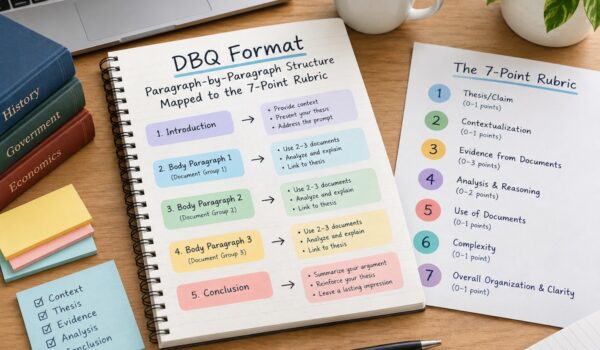
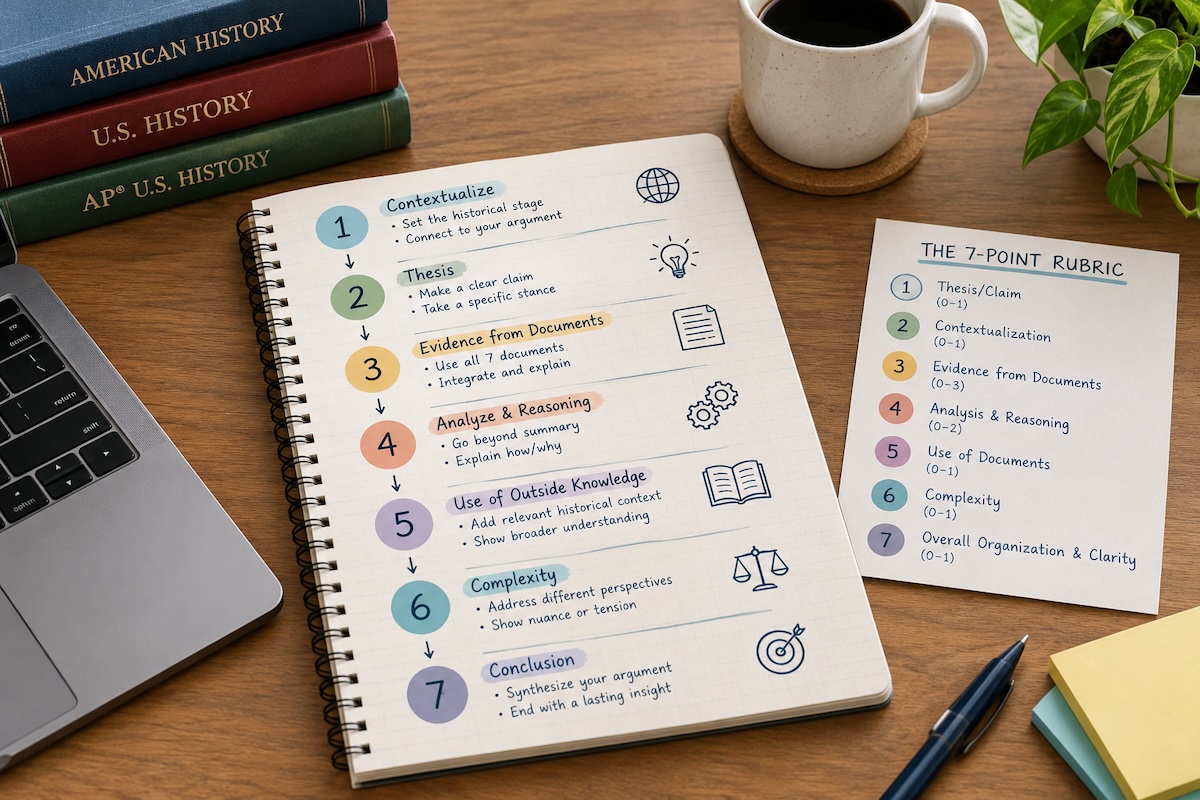
Readers score the DBQ out of 7 points across four rubric rows, and you earn each point independent of the others.
| Rubric row | Points | Criteria | 2025 average (Set 1 / Set 2) |
| Thesis/claim | 1 | A defensible claim with a line of reasoning | 0.79 / 0.85 |
| Contextualization | 1 | A broader context, described and tied to the prompt | 0.62 / 0.60 |
| Evidence from documents | 2 | Describe 3 documents (1 point); use 4 to support an argument (2 points) | 1.34 / 1.42 |
| Evidence beyond documents | 1 | One specific outside example tied to your argument | 0.47 / 0.52 |
| Sourcing | 1 | HIPP explained for 2 documents | 0.39 / 0.38 |
| Complexity | 1 | Sophisticated argument or effective use of evidence | 0.15 / 0.16 |
The averages come from College Board’s 2025 Chief Reader Reports for Set 1 and Set 2. Outside evidence, sourcing and complexity make up three of the seven points, yet their 2025 averages added up to about one point. Your practice time pays off most there. The 2025 scoring guidelines also treat your essay as a first draft, so readers ignore grammar slips unless they hide your meaning.
How Do You Write an APUSH DBQ Step by Step?
Use the SCORE method: Scan the prompt, Collect what you know, Organize the documents, Reason to a thesis, then Execute against the rubric.
| Step | Minutes | Output |
| Scan | 0 to 2 | Reasoning skill, date range and subject |
| Collect | 2 to 5 | A list of context and outside evidence |
| Organize | 5 to 13 | Documents grouped by argument, with HIPP notes |
| Reason | 13 to 15 | A thesis and a paragraph plan |
| Execute | 15 to 60 | The essay plus a rubric check |
Scan the Prompt
Circle the reasoning verb, the dates and the subject. The rubric rejects outside evidence from beyond the prompt’s time period or region, so those dates fence in your whole essay.
Collect What You Know
Before you open Document 1, list events, laws, people and trends tied to the prompt. Broad developments feed your contextualization, and specific named examples feed the outside evidence point. If you read the documents first, you tend to forget your own examples.
Organize the Documents
Write a short margin summary for each document, then sort them into two or three groups that answer the prompt in different ways. Mark two to four documents with a clear HIPP angle, such as a politician courting voters.
Reason to a Thesis
Your document groups become your line of reasoning, the same claim-and-support logic you use in an argumentative essay. For formulas and scored examples, see our guide to writing a DBQ thesis that earns the point. A thesis that opens with “although” sets up the counterargument you need for complexity.
Execute Against the Rubric
Write for about 40 minutes and keep the last five to check your essay row by row. If you fall behind, skip polish and add the move you still lack, such as a second sourced document.
How Should You Structure an APUSH DBQ Essay?
A five-paragraph structure works well: an introduction with context and thesis, three body paragraphs built on document groups, and a short conclusion.
The rubric sets no paragraph count, but a predictable shape helps you place each move. Sketch it like any essay outline:
| Essay section | Points you can earn there |
| Introduction | Contextualization, thesis |
| Body paragraphs 1 and 2 | Evidence from documents, sourcing, outside evidence |
| Body paragraph 3 (counterargument) | Evidence from documents, complexity |
| Conclusion | A backup thesis or a connection across periods |
Write Contextualization That Earns the Point
Describe a broader development from before, during or after the prompt’s time frame and connect it to the topic. A passing phrase earns nothing. For a Progressive Era prompt:
- Near miss: “The late 1800s were a time of big changes in America.”
- Earns the point: “After the Civil War, industrialization concentrated wealth in firms such as Standard Oil, while governments followed laissez-faire policies that left workers and consumers with little protection. In the 1890s, Populist farmers demanded public ownership of railroads and a graduated income tax.”
Build Each Body Paragraph Around an Argument
- Topic sentence: a sub-claim that advances your thesis.
- Document evidence: describe two or three documents in your own words.
- Sourcing: explain how one document’s HIPP strengthens the sub-claim.
- Outside evidence: add an example no document mentions.
- Link back: tie the paragraph to your thesis.
Describe documents instead of quoting them. The rubric withholds credit for bare quotes and for treating several documents as one block.
How Do You Source Documents With HIPP?
To earn the sourcing point, explain how the historical situation, intended audience, purpose or point of view of at least two documents supports your argument.
| HIPP lens | Question to ask | Example |
| Historical situation | What was happening when the author created it? | Upton Sinclair published The Jungle in 1906, as muckrakers exposed corporate abuses. |
| Intended audience | Who did the author want to reach? | Theodore Roosevelt gave his 1910 New Nationalism speech to a Kansas crowd. |
| Purpose | What did the author want to achieve? | Sinclair wrote to build sympathy for immigrant workers. |
| Point of view | How did the author’s position shape the message? | A factory owner testifying before Congress had reasons to defend long workdays. |
The word that matters is relevance. In 2025, readers reported that many students named a document’s purpose or audience but failed to connect it to an argument. Follow each observation with a “which shows” clause:
- Identifies only: “Document 4 is a speech by Theodore Roosevelt to a crowd in Kansas.”
- Explains relevance: “Roosevelt aimed his 1910 speech at ordinary voters, which explains why he framed federal regulation as protection for working families.”
Keep historical situation, which describes one document’s moment, separate from contextualization, which describes the backdrop of the whole prompt.
How Do You Earn the Outside Evidence Point?
Bring in at least one specific example that none of the documents mentions, and explain how it supports your argument.
The example must be more specific than your context, different from your context evidence, more than a passing mention, and inside the prompt’s time and place. Name a law, event, court case or person: “The Keating-Owen Act of 1916 banned the interstate sale of goods made with child labor, showing that Progressives turned to federal commerce power once state reforms fell short.” Add one outside example to each body paragraph so one weak reference does not decide the point.
How Do You Earn the Complexity Point?
Earn complexity by building nuance into your argument from the thesis onward, or by sourcing four documents.
About 15% to 16% of responses earned this point in 2025. The scoring guidelines offer two routes:
- Sophisticated argument: explain multiple causes, effects or perspectives; weigh both continuity and change; or connect developments across periods.
- Effective evidence: use all seven documents, explain HIPP for four, or pair documents with outside evidence to show competing views.
Readers noted that few 2025 essays earned complexity through all seven documents. Stronger essays qualified their main argument with documents that showed a counter-trend. Plan one qualifying paragraph and spread sourcing across your body paragraphs.
APUSH DBQ Example: An Annotated Body Paragraph
Practice prompt: Evaluate the extent to which the Progressive movement changed the role of the federal government in American life from 1890 to 1920.
Thesis: Although Progressive reforms left racial segregation and many workplace abuses untouched, the movement expanded the federal government’s role by making it a regulator of big business and a protector of consumers.
The paragraph below draws on a practice document set, with rubric labels in brackets:
Progressives pushed the federal government to protect consumers from corporate abuse. In Document 2, Upton Sinclair describes spoiled meat and dangerous conditions in Chicago packinghouses [Evidence from documents]. Sinclair, a socialist, wrote The Jungle to win sympathy for immigrant workers, yet readers fixed on food safety, which shows that consumer fears drove reform more than concern for labor [Sourcing: purpose]. Within months, Congress passed the Meat Inspection Act and the Pure Food and Drug Act of 1906 [Outside evidence]. Even so, the Supreme Court struck down federal child labor limits in Hammer v. Dagenhart in 1918, a sign that the new regulatory power stopped short of the workplace [Complexity: qualifies the argument].
The last sentence carries the most weight, because it limits the claim instead of repeating it.
Common APUSH DBQ Mistakes That Cost Points
- Summarizing documents in order. Group them by argument.
- Writing a one-line context. Give two or three connected sentences.
- Recycling context as outside evidence. The rubric requires different evidence for each point.
- Misreading a document. In 2025, many students misread a Barry Goldwater excerpt because it mentioned the needy. Read the full source line and excerpt before you group a document.
Want feedback before test day? Send Homework Help Global a timed practice DBQ, and an editor will review it against the College Board rubric. Request an essay review.
How Should You Practice the DBQ Before May 2027?
Practice with released College Board prompts under timed conditions, then score each essay against the rubric row by row.
Pull prompts, scoring guidelines and samples from the AP Central past exam questions page. Write your first two DBQs untimed, then switch to 60-minute sessions. After each one, highlight each rubric move in a different color; a missing color shows what to fix. Since the 2027 DBQ spans a wider range, build a short evidence list for each of the nine course periods.
Spaced review, covered in our study tips for exams, helps you hold that evidence. The sourcing habits you build here carry over to a history research paper, and the timed-essay routine transfers to the AP Lang rhetorical analysis essay.
Frequently Asked Questions
How many documents do you need to use in an APUSH DBQ?
You need three documents described with accuracy to earn one evidence point and four used to support an argument to earn both. Sourcing requires two documents, explained in terms of their point of view, purpose, audience or historical situation. Using all seven well, or sourcing four, opens two routes to the complexity point. Aim to work six or seven documents into your argument when time allows, and group them by the claim they support instead of discussing them in numerical order. Readers credit a document only when you describe its content with accuracy.
How long should an APUSH DBQ be?
College Board sets no word or page limit for the APUSH DBQ. Readers score your essay against the rubric and treat it as a first draft, so length alone earns nothing. An introduction, three body paragraphs and a short conclusion give you room for all seven points within the 45 minutes of writing time. If you run short, add a missing rubric move, such as a second sourced document, before you add more summary. Clear topic sentences help readers spot each rubric move.
How many paragraphs should a DBQ have?
The rubric sets no paragraph count. A common plan for anyone learning how to write a DBQ for APUSH uses five paragraphs: an introduction with context and thesis, three body paragraphs and a conclusion. Your thesis must appear in one place, either the introduction or the conclusion. Give each body paragraph one sub-claim, two or three documents, a sourcing explanation and an outside example, and use the third body paragraph for a counterargument. A fourth body paragraph helps only if you still finish with time to check the rubric.
Is it possible to get a 7/7 on the APUSH DBQ?
Yes, but a 7 requires each rubric row, including complexity, which about 15% to 16% of responses earned in 2025. Plan complexity from your thesis with an “although” clause, source at least four documents and add a qualifying paragraph. Knowing how to write a DBQ for APUSH row by row turns the rubric into a checklist you can complete under time pressure, and timed practice makes that checklist second nature. Thesis and contextualization had the highest 2025 averages, so lock those in first.
Can someone review my practice APUSH DBQ before the exam?
Yes. Ask your teacher first, and score your draft yourself against the official College Board rubric. Our essay review service also covers practice DBQs and U.S. history assignments. An editor checks your draft against the rubric and points out gaps in contextualization, sourcing, outside evidence and complexity. Send one or two timed essays from different periods so the feedback covers more than one prompt type. Request a free quote and include the prompt and documents with your draft.
Write Your Next APUSH DBQ With a Plan
You now know the format, the rubric and a 60-minute routine you can rehearse. Spend your practice on the rows students miss most: sourcing, outside evidence and complexity.
At Homework Help Global, we help students sharpen their history writing, from practice DBQs to full research papers. Our U.S. history writing support pairs you with editors who review your work against the AP rubric. Get a free quote and send us your next practice essay.