 Toll-Free:


DBQ Format: A Paragraph-by-Paragraph Structure Mapped to the 7-Point Rubric
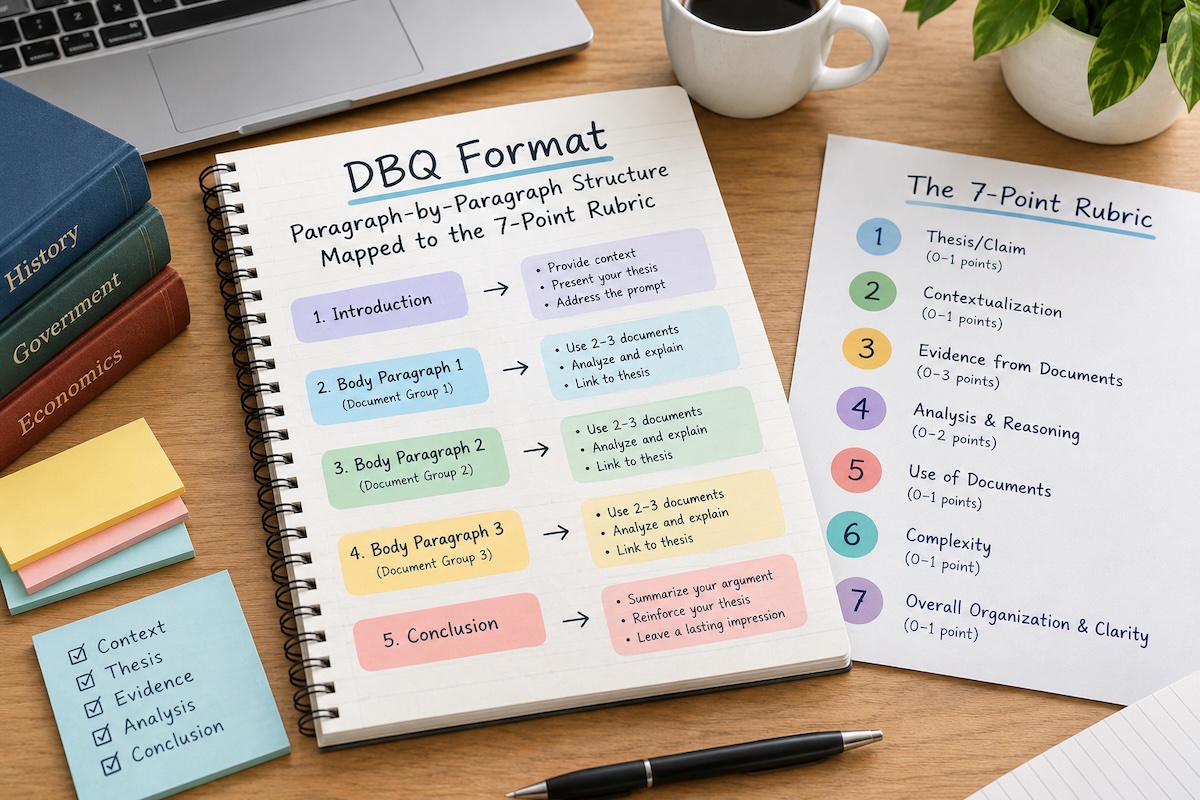
The DBQ format is an introduction with context and a thesis, two to four body paragraphs that group documents by argument, and a short conclusion, built so each part lands a specific rubric point.
The DBQ format trips up students because one essay asks you to argue a claim, use seven primary sources and add outside history in about an hour. Once you see how the AP history rubric maps onto each paragraph, the structure stops feeling like guesswork. Below you get that map, a body paragraph method you can repeat under pressure, and a sample outline for APUSH, AP World History: Modern or AP European History.
Key Takeaways
- The AP history DBQ is worth 7 points and 25% of your exam score, and you get about 60 minutes for it, including a 15-minute reading period.
- Your introduction carries two points (contextualization and thesis), and your body paragraphs carry the remaining five.
- Group documents by argument. Working through them in number order produces summary, which earns little.
- Sourcing counts when you explain how a document’s point of view, purpose, historical situation or audience supports your argument for at least two documents.
Quick Answers
| Question | Answer |
| How many documents? | 7 on the AP history exams |
| How much time? | About 60 minutes, including a 15-minute reading period |
| How many points? | 7 |
| How many paragraphs? | Introduction, two to four body paragraphs, conclusion |
| Minimum documents used? | Four to support an argument for full evidence credit |
Stuck on a practice DBQ or a history essay due this week? Homework Help Global pairs you with a history writer who can draft a model essay or edit yours against the rubric. Get a free quote.
What Is a DBQ?
A document-based question (DBQ) is a timed essay that asks you to answer a historical prompt using a set of provided sources plus your own knowledge. The College Board introduced it on the 1973 AP U.S. History exam to push students past memorized facts and toward the analysis historians do with archives.
You will meet the DBQ in AP U.S. History (APUSH), AP World History: Modern and AP European History. The documents can be letters, speeches, laws, political cartoons, maps or data tables, and most will be new to you, so reading an unfamiliar source counts for more than recall.
What Does the DBQ Format Look Like on the AP Exam?
The DBQ opens Section II of each AP history exam, and you type it in the Bluebook testing app. According to the College Board’s AP U.S. History exam page, the section looks like this:
| Feature | DBQ details |
| Position | First question in Section II |
| Documents | 7, offering different perspectives on one development |
| Recommended time | 60 minutes, including a 15-minute reading period |
| Share of exam score | 25% |
| Paired with | One long essay question (LEQ), 40 minutes, 15% |
From the May 2027 exams, a DBQ prompt can span a wider stretch of the course. The AP History Exam Updates page confirms the rubric and evidence requirements stay the same, so this format still applies.
How Does the DBQ Rubric Shape Your Essay Structure?
Each paragraph in a strong DBQ exists to earn points. Read the rubric first, and the format follows from it.
| Rubric row | Points | Requirement | Location |
| Thesis/claim | 1 | Make a defensible claim that sets up a line of reasoning | End of introduction |
| Contextualization | 1 | Describe broader events before, during or after the prompt’s period | Start of introduction |
| Evidence from documents | 2 | Describe 3 documents (1 point) or use 4 to support an argument (2 points) | Body paragraphs |
| Evidence beyond documents | 1 | Use one specific example the documents do not mention | Body paragraphs |
| Sourcing | 1 | Explain how point of view, purpose, situation or audience matters for 2 documents | Body paragraphs |
| Complexity | 1 | Show sophisticated argument or evidence use | Across the essay |
Two scoring notes catch students out: a quote with no description earns nothing, and your outside example must differ from your contextualization.
What Is the Standard DBQ Format?
Use this skeleton as your default and stretch it to four body paragraphs when the prompt invites more categories.
- Introduction: 2 to 4 sentences of context, then your thesis
- Body paragraph 1: first category of your argument, 2 or more documents
- Body paragraph 2: second category, 2 or more documents
- Body paragraph 3 (optional): third category, counterargument or qualification
- Conclusion: 2 or 3 sentences that extend the argument
Introduction: Contextualization Plus Thesis
Open with the bigger picture. For a prompt on 1865 to 1910, you might describe European competition for colonies. Give it several sentences, since the rubric gives no credit for a passing phrase such as “industrialization happened.”
Close the introduction with a thesis that answers the prompt and names your categories. Our DBQ thesis formula guide has templates for each prompt type. For general openings, see how to write an introduction.
Body Paragraphs: The CEDAR Method
Build each body paragraph with five moves:
- C: Claim. Open with a topic sentence that states one category from your thesis.
- E: Evidence. Describe two or more documents in your own words and tie each to the claim.
- D: Document sourcing. Pick one document and explain why its author, purpose, audience or setting strengthens your point.
- A: Add outside evidence. Bring in one named event, law, person or movement from your course notes.
- R: Return to the thesis. End by showing how the paragraph advances your overall answer.
Run CEDAR in two or three paragraphs and you cover four documents, two sourced documents and an outside example, which locks in four of the five body-paragraph points. The method mirrors the claim-evidence-analysis pattern in our guide to writing an analytical essay.
Conclusion
Restate your thesis in new words, then add one connection: a later period, a limit to your argument, or a tension between documents. Graders can award complexity for insight here. Our guide on how to write a conclusion covers closing moves that avoid repetition.
How Do You Source a Document in a DBQ?
Teachers often teach sourcing with the acronym HIPP (or HAPP): Historical situation, Intended audience, Purpose and Point of view. One of the four per document is enough, as long as you explain its relevance. Naming the audience on its own earns no credit.
- Identifies: “Document 4 addresses Congress.”
- Explains relevance: “Because Document 4 is a presidential message to Congress, Roosevelt frames expansion as national security, the case best suited to win votes for a larger navy.”
Stems such as “As a [role], the author had reason to…” or “Because the audience was [group], the author emphasizes…” help under pressure. Source two documents for the point, or four to open a route to complexity. Our guide to what counts as an academic source builds the same habit of questioning a source.
Where Does Outside Evidence Go?
Outside evidence belongs inside a body paragraph, next to the documents it supports. Pick something specific, such as the Chinese Exclusion Act, the Corn Laws or the Meiji Restoration, and explain in a sentence how it connects to your claim.
Context sets the stage in broad strokes before your argument begins. Outside evidence is one named example that proves a point inside the argument. Use the same example for both and you earn one point instead of two.
How Do You Earn the Complexity Point?
The complexity point rewards depth. The College Board lists several routes, and you need one:
- Explain multiple causes or perspectives, or both cause and effect.
- Connect your argument to another period or region.
- Qualify your thesis with evidence that shows its limits.
- Use all seven documents to support your argument.
- Source four documents in a way that supports your argument.
The last two routes give you a concrete target to plan during the reading period.
How Should You Spend Your 60 Minutes?
| Phase | Time | Task |
| Read the prompt | 2 minutes | Circle the task verb, time span and region |
| Read and annotate | 13 minutes | Note each document’s main idea and one HIPP angle |
| Plan | 5 minutes | Group documents into categories, write the thesis |
| Write | 35 minutes | Introduction, body paragraphs with CEDAR, conclusion |
| Review | 5 minutes | Check document count, sourcing and outside evidence |
Want a second set of eyes on your DBQ before the exam? Homework Help Global editors review practice essays against the AP rubric and show you which points you left on the table. Request a free quote.
DBQ Format Example: A Sample Outline
Here is an outline for an AP European History style prompt, using an illustrative set of seven documents.
Prompt: Evaluate the extent to which industrialization changed working conditions in Britain from 1750 to 1850.
Documents (illustrative): (1) factory inspector’s report, (2) mill owner’s testimony to Parliament, (3) textile wage table, (4) Chartist petition, (5) novelist’s account of a factory town, (6) doctor’s public health report, (7) factory floor cartoon.
Introduction
- Context: enclosure pushed rural families toward towns, and steam power moved production into mills.
- Thesis: Industrialization transformed working conditions by imposing factory discipline and dangerous labour on women and children, though rising wages for some skilled workers limited the change.
- Body 1, discipline and danger (Docs 1, 6, 7): source the inspector’s report, which Parliament commissioned to build a case for reform; add the Factory Act of 1833 as outside evidence.
- Body 2, women and child labour (Docs 1, 4, 5): source the novelist, who wrote to stir middle-class readers and foregrounds suffering.
- Body 3, limits of change (Docs 2, 3): source the mill owner, who had a motive to call conditions fair.
- Conclusion: connect to later labour reform and trade unions.
The outline uses all seven documents and sources four, which sets up both evidence points and a route to complexity. For longer history writing, see our guide on how to write a history research paper.
Common DBQ Format Mistakes
- Marching through documents in order. Organizing by document number produces summary. Organize by argument.
- Quoting instead of describing. A pasted quote with no explanation earns no evidence credit.
- Naming the source without explaining it. “The author is a senator” is identification. Say why that matters to your claim.
- One-line contextualization. A single phrase about the era falls short of the rubric.
- Reusing context as outside evidence. Graders need two different pieces of history.
[E-E-A-T: add an anonymised student scenario, e.g., a practice DBQ our editors reviewed that moved from 3 to 6 points by regrouping documents and adding sourcing.]
Is the DBQ Format the Same for APUSH, AP World and AP Euro?
Yes. The three AP history courses share one DBQ rubric, one timing model and one seven-document structure. The content changes: APUSH runs from 1491, AP Euro from 1450 and AP World from 1200, each to the present, so your outside evidence must fit the course.
Other exams differ. IB history papers ask several questions about a smaller source set, including the value and limitations of a source, and New York Regents exams use their own document-based tasks and rubrics. Check your teacher’s instructions before you assume the AP format applies.
Conclusion
The DBQ format rewards planning more than speed. Put context and a defensible thesis in your introduction, run the CEDAR method through two or three body paragraphs, source with purpose, and close with one idea that pushes your argument further. Practise that structure on released College Board prompts until it becomes automatic.
At Homework Help Global, our history writers and editors work with students on DBQs, long essays and research papers each term. If you want a model DBQ to study, feedback on a practice essay, or help with a history assignment that is eating your week, our team is ready to help. Get your free quote and tell us what you need.
Frequently Asked Questions
How many paragraphs should a DBQ be?
Most strong DBQs have four or five paragraphs: an introduction, two or three body paragraphs and a short conclusion. The rubric sets no paragraph count. Two well-developed body paragraphs can earn full marks if they use at least four documents, source two of them and include outside evidence. Add a third body paragraph when your thesis names three categories or when you want room for a counterargument. A fourth body paragraph seldom pays off in 35 minutes of writing time, so spend those minutes on sourcing instead.
How many documents do you need to use in a DBQ?
Use at least four of the seven documents to support your argument for the full two evidence points. Describing the content of three documents earns one point. Using all seven, with accurate description, gives you one route to the complexity point. Sourcing is a separate row: explain the point of view, purpose, historical situation or audience for at least two documents. Plan your document use during the 15-minute reading period so each body paragraph has two or three sources assigned before you start typing.
Can you use the five-paragraph essay format for a DBQ?
You can, as long as each body paragraph argues one category from your thesis. A five-paragraph essay becomes a problem when it forces you into three thin paragraphs or one document per paragraph. Group documents by idea, add sourcing and outside evidence in each paragraph, and the five-paragraph shell becomes a solid DBQ format. Treat the five-paragraph model as a starting point, then cut or add a body paragraph to fit the categories your thesis sets up.
Do you need a conclusion in a DBQ?
The rubric awards no separate point for a conclusion, so a DBQ can score 7 without one. A short conclusion still helps. Graders accept a thesis that appears in the conclusion, which protects you if your opening claim was weak. A closing connection to another period, or a qualification of your argument, can also earn the complexity point. Keep it to two or three sentences and avoid summarizing each paragraph, since a recap adds words without adding points.
Can someone help me with my DBQ essay?
Yes. Our history writers can draft a model DBQ on your prompt and documents so you can study how each paragraph earns its points under the DBQ format. Our editors can also review your practice essay against the AP rubric, flag missing sourcing or outside evidence, and suggest fixes before your next timed attempt. Share your prompt, documents and deadline through our free quote form, and we will match you with a writer who knows APUSH, AP World or AP Euro.