 Toll-Free:



Paraphrase vs Summary: Key Differences, Examples, and When to Use Each
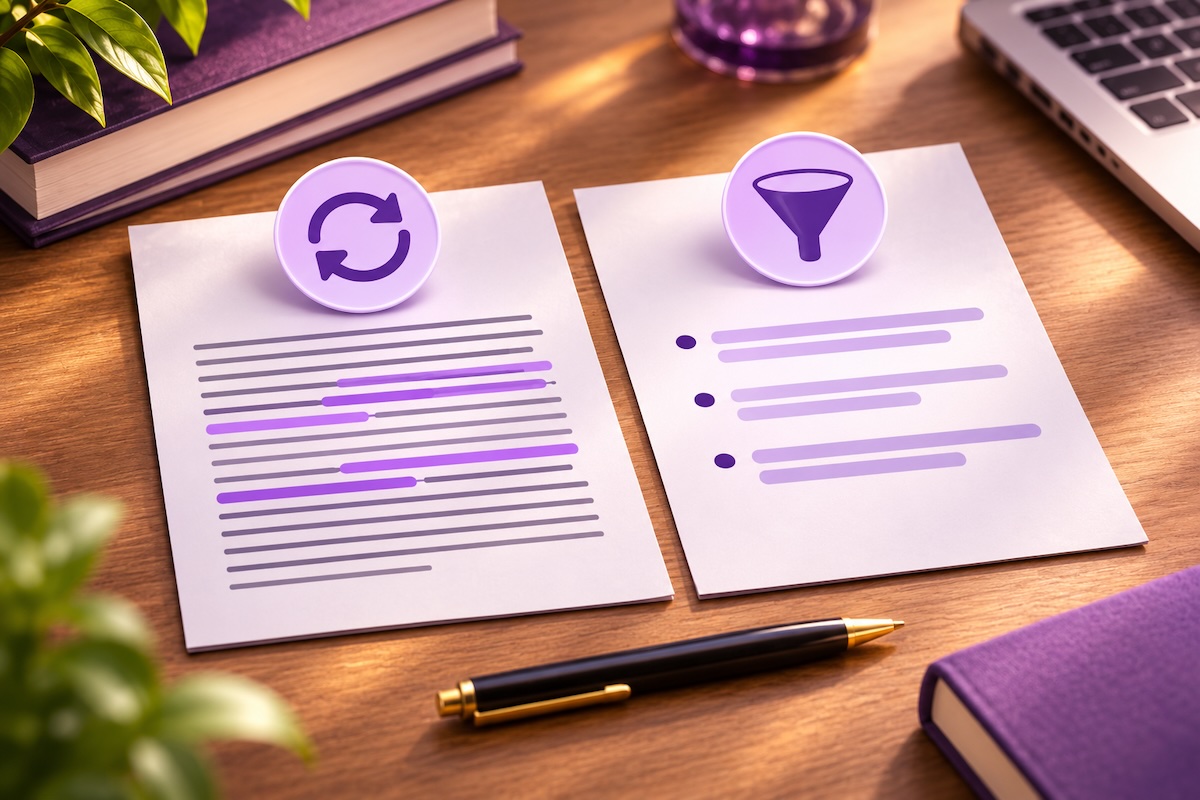
A paraphrase restates one specific passage in your own words at about the same length. A summary condenses the main ideas of a longer source into a much shorter version, and you cite both.
The paraphrase vs summary question tends to surface the moment a marker writes “too close to the source” in your margin. Both techniques put another writer’s ideas into your words. They differ in scope, length and purpose, and the wrong choice can weaken your argument or put your academic integrity at risk.
Information verified November 23, 2026.
Quick Answers
| Paraphrase | Summary | Direct quote | |
| Covers | A sentence or short passage | A full article, chapter or book | The exact words you need |
| Length | About the same as the original | About a quarter of the original or less | Identical to the original |
| Wording | Yours | Yours | The author’s, in quotation marks |
| Detail | Each point in the passage | Main ideas only | As written |
| Citation | Required | Required | Required, with a page number |
| Best for | Specific evidence | Background and overviews | Wording that matters |
Key Takeaways
- Paraphrase a specific point. Summarize a whole source or a long section of one.
- A paraphrase keeps the detail, and a summary keeps the main argument.
- Both need an in-text citation and a reference list entry.
- Swapping synonyms into the author’s sentence structure counts as patchwriting, even with a citation.
Not sure your source use will pass? The editors at Homework Help Global check paraphrases, summaries and citations before you submit. Get a free quote.
What Is a Paraphrase?
A paraphrase restates a short passage in your own words and sentence structure, keeping its full meaning and detail.
You paraphrase a sentence, a few sentences or a paragraph, and the result runs about as long as the original. MIT’s writing guidance sets four tests: a paraphrase must be accurate, complete, written in your own words and able to make sense by itself.
Paraphrase works best for specific evidence, such as a statistic or definition, and for technical wording that would slow your reader down. APA Style notes that published authors paraphrase their sources more often than they quote them, and it encourages students to do the same.
What Is a Summary?
A summary condenses the main ideas of a source into a short overview in your own words, leaving out minor details and examples.
You summarize a longer piece: an article, a chapter, a book or a long section of a report. A common rule of thumb puts a summary at about 25 percent of the original’s length, and many run far shorter. In a literature review, one sentence can cover a 30-page study.
A summary can reorder the source’s ideas. It reports the author’s argument, so keep your opinion out unless the assignment asks for one.
Summary works best for background, literature reviews and introducing a source before you analyse it. For a step-by-step method, see our guide on how to summarize an article.
What Is the Difference Between a Paraphrase and a Summary?
The core difference is scope: a paraphrase rewords a specific passage in full, and a summary shrinks a larger work to its main points.
- Scope and length. A paraphrase handles a passage at close to its original length. A summary handles a whole work and cuts it down to a fraction.
- Detail and order. A paraphrase keeps each point in the source’s sequence. A summary keeps the main ideas and can rearrange them.
- Purpose. A paraphrase supplies precise evidence. A summary supplies context.
Quotation sits beside both as a third option. Purdue OWL advises writers to keep direct quotations to a minimum, so save them for wording that matters as much as the idea. Summary also differs from synthesis, which combines several sources to build a new point. Our synthesis vs summary guide covers that split.
Paraphrase vs Summary Example: One Passage, Three Ways
Rewriting one passage as a quote, a paraphrase and a summary shows the difference in length and detail at a glance.
Our team wrote this practice passage, so the figures are illustrative and the citations use a placeholder author.
Original passage:
Many university students now hold part-time jobs during the academic term to cover tuition and living costs. Students who work fewer than 15 hours a week often report better time management and higher motivation than peers who do not work at all. Once weekly hours climb past 20, the pattern reverses: students sleep less, skip more classes and earn lower grades. The number of hours, rather than the job itself, appears to shape the academic outcome. (Author, 2025, p. 12)
Direct Quote
Author (2025) concludes that “the number of hours, rather than the job itself, appears to shape the academic outcome” (p. 12).
Changes: The words inside the quotation marks stay the same. The citation carries a page number, which APA requires for direct quotes.
Paraphrase
To pay for school and day-to-day expenses, a growing number of university students take paid work while classes are in session. Author (2025) found that a light schedule of under 15 hours a week tends to come with stronger planning skills and motivation. Past 20 hours, the trend flips, and students lose sleep, miss lectures and see their marks drop. Author ties the effect on grades to workload more than to employment itself (p. 12).
Changes: Each point survives at about the same length. The vocabulary and sentence structure are new.
Summary
Author (2025) found that working more than 20 hours a week hurts students’ grades, while lighter schedules can help (p. 12).
Changes: Four sentences shrink to one. The summary drops the tuition detail, the sleep and attendance effects, and the 15-hour figure.
When Should You Paraphrase or Summarize? Use the SPAN Check
Ask four questions before you write. The answers tell you whether to paraphrase, summarize or quote.
- S: Size. Are you drawing on a paragraph or a full article? Short passages point to paraphrase, and long ones point to summary.
- P: Purpose. Does the source prove a specific claim or set up context? Proof calls for paraphrase. Context calls for summary.
- A: Amount of detail. Does your reader need the numbers or the headline finding alone? Detail calls for paraphrase.
- N: Need for exact wording. Would rewording change the meaning or lose a phrase you plan to analyse? If so, quote.
Your discipline shapes the mix too. The University of Toronto’s writing advice notes that science literature reviews lean almost wholesale on summary, while argumentative essays blend all three techniques.
Three Canadian Student Scenarios
- Nursing case study. The precise conditions in a fall-prevention guideline matter, so you paraphrase it and cite the page.
- History essay. A book on the Winnipeg General Strike serves as background, so you summarize its argument in two sentences.
- Psychology literature review. You cover 12 studies on sleep and memory. You summarize each in a sentence, then compare them, which moves you toward synthesis.
Working on a literature review or research paper? Our editors flag patchwriting, missing citations and overlong summaries, then return comments you can act on. Request a free quote or see our editing services.
How Do You Paraphrase Without Plagiarizing?
Read the passage until you understand it, write your version without looking, then compare the two and cite.
- Read for meaning until you can explain the passage out loud.
- Put the source away and close the tab.
- Write from memory in your own sentence structure. Changing word forms helps, such as turning a verb into a noun.
- Compare your version with the original. Put any distinctive phrase you kept in quotation marks.
- Cite the source in your text and reference list.
What Is Patchwriting?
Patchwriting is a failed paraphrase: the writer swaps in synonyms but keeps the source’s sentence structure and order of ideas.
A UBC Okanagan academic integrity handout calls patchwriting often accidental and as serious as any other type of plagiarism. A citation does not fix it, because your sentence still borrows the author’s construction.
Patchwritten: Many college students now have part-time jobs during the school term to pay tuition and living expenses (Author, 2025).
Paraphrased: To pay for school and day-to-day expenses, a growing number of university students take paid work while classes are in session (Author, 2025).
The patchwritten version tracks the original with five swaps. The paraphrase rebuilds the sentence.
[HHG EDITOR INSIGHT: add one anonymised example from a recent edit where a student’s paraphrase was flagged as patchwriting, and what the editor changed]
For more ways to protect your work, read our guide on avoiding plagiarism through citations and referencing.
How Do You Cite a Paraphrase and a Summary?
Cite both the way you cite a quote: an in-text citation in your sentence and a full entry in your reference list.
In APA 7, the author and year are required. APA Style treats a page or paragraph number as optional for a paraphrase. Add one when it helps readers find the passage in a long work such as a book. A paraphrase that runs several sentences needs the citation once, at first mention. Start a new paragraph and you cite again.
In MLA 9, give the author’s last name and the page number with no comma: (Author 12). Our APA format guide and MLA referencing guide cover reference entries. If you’re unsure an idea needs a citation at all, read our post on understanding when to reference.
Can You Use AI Paraphrasing Tools for Assignments?
Use them only if your instructor allows it. Many Canadian universities treat unapproved AI use, including paraphrasing apps, as academic misconduct.
At the University of Toronto, students may not use generative AI in a course unless the instructor gives permission. The UTM academic integrity office notes that paraphrasing apps derive from generative AI and some courses do not allow them. In July 2024, Turnitin also added AI paraphrasing detection to its AI writing report.
Before you open a paraphrasing tool, check the syllabus and the assignment instructions, follow any disclosure rules, and ask your instructor if the policy is unclear. The paraphrase you submit should come from your own reading.
Conclusion
Paraphrase a specific point you need in full detail, and summarize a broader idea your reader needs in brief. Cite both, and rebuild each sentence instead of swapping synonyms.
At Homework Help Global, we help Canadian students get source use right before a marker sees it. Our editors review paraphrases, summaries and citations, and our article summary service gives you a clear overview of dense readings to study from. Get your free quote today and send us your draft.
Frequently Asked Questions
Is a summary shorter than a paraphrase?
Yes. A summary condenses a source to its main ideas, so it runs much shorter than the original, often a quarter of the length or less. A one-page article might become two or three sentences. A paraphrase keeps each point of the passage it restates, so it stays close to the original length and can run a little shorter. In the paraphrase vs summary choice, length follows from how much detail your reader needs.
Do you need to cite a paraphrase and a summary?
Yes. Both use another author’s ideas, so both need an in-text citation and a reference list entry. In APA, include the author and year, and add a page number when it helps readers find the passage in a long work. In MLA, give the author’s last name and the page number. Leaving out the citation counts as plagiarism, even when the words are your own. Your instructor’s rubric may also set extra rules, such as page numbers for each paraphrase, so check it before you submit.
Is paraphrasing considered plagiarism?
Paraphrasing with a citation is a standard, accepted academic skill. It becomes plagiarism in two cases. The first is leaving out the citation. The second is patchwriting, where your version copies the source’s sentence structure and swaps in a few synonyms. Universities treat patchwriting as plagiarism even when you cite the source. To stay safe, rebuild each sentence from your own understanding, keep any borrowed phrase in quotation marks, and cite the source in your text and reference list.
What is the difference between paraphrasing, summarizing and quoting?
Quoting copies the author’s exact words inside quotation marks, with a page number. Paraphrasing restates a specific passage in your own words at about the same length. Summarizing condenses the main ideas of a longer source into a short overview. Each one needs a citation. Quote when the wording itself matters, paraphrase for detailed evidence, and summarize for context or background. Most strong academic papers lean on paraphrase and summary, and they keep direct quotes for the few lines a writer plans to analyse.
Can Homework Help Global check my paraphrases and summaries before I submit?
Yes. Our editors review your draft for patchwriting, missing or incorrect citations, and summaries that carry too much detail. You get comments that explain each change, so you learn the paraphrase vs summary distinction as you revise. We also check that your in-text citations match your reference list. Request a free quote through our Canadian quote form, and an editor will confirm the turnaround for your deadline.