 Toll-Free:


APA 6 vs APA 7: Every Difference That Changes Your Paper
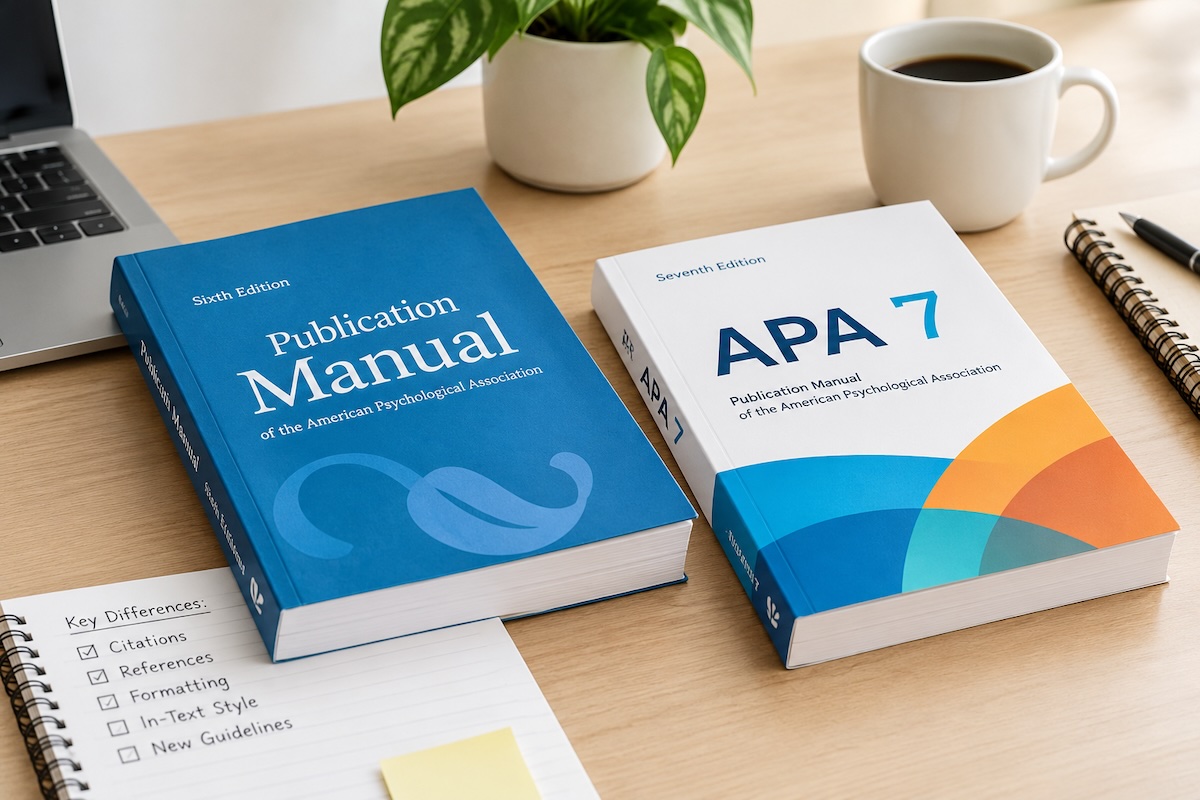
The main differences in APA 6 vs APA 7 are a simpler student title page with no running head, “et al.” from the first citation for three or more authors, no publisher locations, DOIs written as links and up to 20 authors in each reference.
Last verified against APA Style sources on October 19, 2026.
The APA 6 vs APA 7 question still trips up students, because older templates, library guides and citation tools often default to the sixth edition. The American Psychological Association published the seventh edition of its Publication Manual in October 2019, with a 2020 date, and it replaced the 2009 sixth edition. Most of the changes make papers easier to format. A few, like the et al. rule, change citations across most pages of a typical paper.
This guide puts both editions side by side, shows before/after examples and gives you a five-step method to convert an older paper.
Key Takeaways
- APA 7 adds a separate student paper format with no running head, no abstract and no author note unless your instructor asks for them.
- Use “et al.” from the first in-text citation for any source with three or more authors.
- References drop publisher locations and “Retrieved from,” list up to 20 authors and format DOIs as https links.
- Your instructor or institution decides which edition you use, and APA’s site lists no eighth edition as of October 2026.
Quick Answers
| Rule | APA 6 | APA 7 |
| Published | 2009 | October 2019 (dated 2020) |
| Student running head | Required, with “Running head:” label | Not required |
| In-text, 3 to 5 authors | All names at first citation | First author + et al. from the start |
| Authors in a reference | Up to 7 | Up to 20 |
| Publisher location | Included | Omitted |
| DOI format | doi:10.xxxx | https://doi.org/10.xxxx |
| “Retrieved from” | Before URLs | Only with a retrieval date |
| Spaces after a period | Two | One |
Switching a paper to APA 7? Homework Help Global editors can check your citations, references and title page against the seventh edition. Get a free quote.
What Is the Difference Between APA 6 and APA 7?
APA 7 keeps the core author-date system of APA 6 but simplifies formatting, splits student and professional papers, and standardizes references for online sources.
The seventh edition’s biggest structural change is the split between student and professional papers. Students get a shorter title page and drop several elements that journal manuscripts still need. According to APA’s product page, the edition also added more than 100 new reference examples, a chapter on bias-free language and more accessible formatting options. APA’s own guide to what’s new in the seventh edition lists each change section by section. For a full walkthrough of seventh edition basics, see our guide on what APA is and how to use it.
Which APA Edition Should You Use in 2026?
Use APA 7 unless your instructor or institution tells you otherwise, since APA 7 is the current edition and APA’s website covers only the seventh edition.
APA set no single cutoff date for the switch. Its transition guidance leaves the decision to each institution or professor and suggests that students finish any paper already started in sixth edition. Journals decide on their own timelines. As of October 2026, APA’s manual page makes no mention of an eighth edition, so APA 7 remains the standard for coursework in Canada and the U.S.
How Did Paper Formatting Change in APA 7?
APA 7 simplified the student title page, removed the student running head, widened font choices and reformatted three heading levels.
Title Page
An APA 6 title page carried a running head, the title, your name and your institution. The APA 7 student title page lists the bold title, your name, your department and institution, the course number and name, your instructor and the due date. A page number sits in the top right corner.
Running Head
Students no longer need a running head unless an instructor requests one. Professional papers still use one, capped at 50 characters, but the “Running head:” label is gone from the first page.
Fonts and Spacing
APA 6 favoured 12-point Times New Roman. APA 7 accepts accessible fonts such as 11-point Calibri, 11-point Arial, 10-point Lucida Sans Unicode, 12-point Times New Roman and 11-point Georgia. Use one space after a period, down from two.
Headings
| Level | APA 6 | APA 7 |
| 1 | Centered, bold, title case | Centered, bold, title case |
| 2 | Flush left, bold, title case | Flush left, bold, title case |
| 3 | Indented, bold, sentence case, ends with a period | Flush left, bold italic, title case |
| 4 | Indented, bold italic, sentence case, ends with a period | Indented, bold, title case, ends with a period |
| 5 | Indented, italic, sentence case, ends with a period | Indented, bold italic, title case, ends with a period |
Tables and Figures
APA 7 formats tables and figures the same way. Bold the number (“Table 1” or “Figure 1“), place an italic title-case title on the next line, and put both above the table or figure. In APA 6, figure captions sat below the image. You can now embed tables and figures in the text or place them after the references.
How Did In-Text Citations Change?
APA 7 uses the first author’s surname and “et al.” for three or more authors in each citation, including the first.
| Authors | APA 6 first citation | APA 7 citation |
| 1 | (Chen, 2021) | (Chen, 2021) |
| 2 | (Chen & Okafor, 2021) | (Chen & Okafor, 2021) |
| 3 to 5 | (Chen, Okafor, & Martin, 2021), then (Chen et al., 2021) | (Chen et al., 2021) |
| 6 or more | (Chen et al., 2021) | (Chen et al., 2021) |
The other in-text rules, such as how to separate two sources that shorten to the same et al. form, carry over unchanged.
How Did the Reference List Change?
APA 7 references drop the publisher location and most “Retrieved from” labels, list up to 20 authors and present DOIs and URLs as live links.
| Element | APA 6 | APA 7 |
| Authors | Up to 7; then first 6, ellipsis, last author | Up to 20; then first 19, ellipsis, last author |
| Publisher location | City, State: Publisher | Publisher only |
| DOI | doi:10.1000/xyz123 | https://doi.org/10.1000/xyz123 |
| Journal issue number | Only if each issue starts at page 1 | Included whenever the journal has one |
| Website | Retrieved from URL | Site name, then URL |
| Ebook | [Kindle version] and URL | Publisher and DOI or URL; no device |
| Author as publisher | “Author” in publisher position | Publisher left out |
Here is the same book in each edition:
- APA 6: Martin, S. (2020). Writing in the social sciences. Toronto, Canada: Harbour Press.
- APA 7: Martin, S. (2020). Writing in the social sciences. Harbour Press.
And the same journal article:
- APA 6: Chen, L., Okafor, D., & Martin, S. (2021). Study habits in first-year students. Journal of Learning Research, 14, 22-35. doi:10.1000/xyz123
- APA 7: Chen, L., Okafor, D., & Martin, S. (2021). Study habits in first-year students. Journal of Learning Research, 14(2), 22-35. https://doi.org/10.1000/xyz123
APA 7 still uses “Retrieved” for pages that change over time and need a retrieval date. Building an annotated bibliography? Apply these same reference rules to each entry.
What Changed in Bias-Free Language?
APA 7 added a full chapter on bias-free language and endorsed the singular “they.”
The chapter updates guidance on age, disability, gender, racial and ethnic identity and sexual orientation. It adds new sections on research participation, socioeconomic status and intersectionality. In practice, write “people living in poverty” over “the poor,” report exact age ranges over broad labels, and use “they” for a person whose pronoun you do not know or who uses “they.”
What Stayed the Same Between APA 6 and APA 7?
The author-date citation system, double spacing, one-inch margins and the alphabetized reference list with hanging indents all carried over from APA 6 to APA 7.
You still cite the author’s surname and the year in the text, and you still match each citation to a full entry in the reference list. Both editions use an ampersand inside parentheses and “and” in narrative citations. Paragraphs still start with a half-inch indent, and the reference list still sorts by the first author’s surname. If your APA 6 paper followed these basics, the conversion work sits in the details covered above.
How Do You Convert an APA 6 Paper to APA 7?
Use the SHIFT method: update the Student title page, Headings and fonts, In-text citations, then Fix references and Terms.
- Student title page: delete the running head and “Running head:” label, bold the title, and add your course, instructor and due date.
- Headings and fonts: reformat Level 3 to 5 headings, confirm an approved font and remove double spaces after periods.
- In-text citations: search for each citation with three to five authors and shorten it to the first author plus et al.
- Fix references: delete publisher locations and “Retrieved from,” convert DOIs to https links, add issue numbers and remove ebook device labels.
- Terms: scan for labels such as “the elderly” and replace them with specific, people-first wording.
Search your document for “doi:”, “Retrieved from” and a colon after a city name. Each hit points to an APA 6 leftover.
Common Mistakes When Switching From APA 6 to APA 7
- Mixing editions in one paper. A single APA 6 reference stands out in a seventh edition list. Convert all entries in one pass.
- Trusting citation generator defaults. Some tools and older templates still output sixth edition formats. Check the edition setting before you export.
- Keeping the “Running head:” label. Even professional papers no longer use the label.
- Dropping the issue number. APA 7 requires it whenever the journal assigns one.
For a broader final check, our essay proofreading tips cover the formatting slips that cost marks.
Short on time before a deadline? Send Homework Help Global your draft, and an editor will convert the citations and references to APA 7. Explore editing services.
If your course also uses MLA, compare the two systems in our post on the difference between MLA and APA. For page-level layout across styles, see our essay format guide, and for full seventh edition examples by source type, use our complete APA formatting guide.
Frequently Asked Questions
Is APA 6 still accepted?
Some instructors and journals still accept APA 6, but APA has replaced it with the seventh edition. APA left the switch date to each institution and professor, and its website now covers only the seventh edition. Check your syllabus or assignment instructions first. If they do not name an edition, use APA 7. If you started a long paper in APA 6 and your instructor allows it, APA’s transition guidance supports finishing that paper in the sixth edition. Do not mix the two editions within one paper.
Do you still need a running head in APA 7?
Students do not need a running head in APA 7 unless an instructor asks for one. A student paper carries only a page number in the top right corner of each page. Professional papers submitted for publication still need a running head of 50 characters or fewer, written in capital letters, but the “Running head:” label no longer appears on the first page. Students working toward publication, such as thesis writers, should ask which format their committee expects.
When did APA 7 come out?
APA released the seventh edition of the Publication Manual in October 2019, and the book carries a 2020 date. Many students started using it in spring 2020. People who compare APA 6 vs APA 7 mean the 2009 sixth edition and this 2019 release. APA kept its sixth edition resources online through August 2021 to help students finish papers already in progress. Any template or citation tool built before 2020 may still use the sixth edition.
Is there an APA 8th edition?
As of October 19, 2026, APA’s official Publication Manual page lists the seventh edition as current and makes no mention of an eighth edition. APA 7 remains the standard for student papers and journal submissions. Watch the APA Style website for announcements, and expect a transition period like the one between APA 6 vs APA 7, with instructors setting their own switch dates. Until then, the seventh edition rules in this guide apply to your coursework.
Can someone check my paper’s APA 7 formatting?
Yes. Start with your school’s writing centre or library, which often reviews citation formatting for free. For a faster turnaround or a full edit, our editors can review your title page, headings, in-text citations and reference list against the seventh edition. Send your draft and the assignment instructions with your quote request so the editor knows which edition your instructor requires. Mention any departmental style notes, such as a required running head, as well.
Get Your Next Paper APA 7 Ready
Most APA 7 changes save you work: fewer title page elements, shorter citations and cleaner references. Run the SHIFT method on any older paper, and check your citation tool’s edition before you export a single reference.
At Homework Help Global, we help students format, cite and polish papers in APA, MLA and Chicago styles. If you want a second set of eyes on your references or a full edit before you submit, get a free quote and send us your draft.